How a Suit Should Actually Fit: Eight Checkpoints Petaling Jaya Professionals Should Know
From shoulder seam to trouser break, here are the eight checkpoints Lanwin Tailor uses to evaluate a suit's fit on Petaling Jaya executives.

A suit that fits you correctly does something quietly powerful. It takes your existing posture, frame, and presence, and amplifies all of it without drawing attention to itself. A suit that fits poorly does the opposite. It distracts the people in front of you, and worse, it distracts you from being fully present in the room.
Most professionals walking into our Petaling Jaya workshop have spent years tolerating fit problems they assumed were normal. The shoulder seam that sits a centimetre too far down. The collar that gaps when they reach for a folder. The trouser break that pools awkwardly over the shoe. These are not normal. They are correctable, and once you know the eight checkpoints below, you will never miss them again.
Why Fit Matters More In A Tropical City
Before we get into the checkpoints, here is a piece of context that international fit guides almost always miss. In Petaling Jaya, your suit has to work harder than the same garment would in London or Tokyo.
- Heat softens cloth quickly, so any fit fault becomes more visible by 4 pm
- Air-conditioned offices stiffen wool unevenly, making poor armhole construction more obvious
- The drive into Section 13 from places like Subang Jaya means a jacket spends an hour collapsed against a car seat before it ever reaches a meeting
A well-cut suit handles all of this gracefully. A poorly cut one shows every sin.
Checkpoint One: The Shoulders
The shoulder is the foundation of jacket fit. Get this wrong and the entire silhouette collapses, no matter how good the rest of the work is.
The seam position. Run a finger from your collarbone outward. The shoulder seam should end exactly where your natural shoulder ends, right at the pivot point where the arm begins. A seam past this point makes the jacket look borrowed. A seam too high makes it look pinched.
The lie of the cloth. The fabric between your neck and the shoulder seam should lie completely flat. Ripples or bunching here mean the “shoulder pitch” of the jacket does not match your real-world posture.
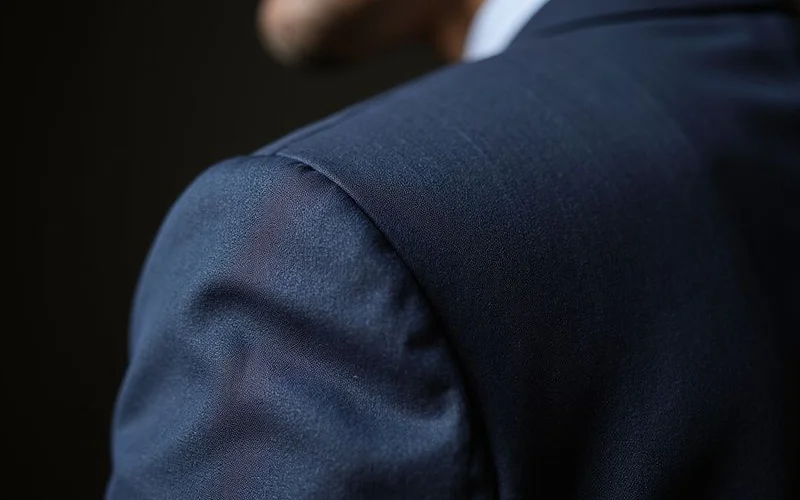
The drape into the sleeve head. Look for divots or dimples where the sleeve joins the shoulder. These signal a mismatch between the armhole shape and the natural angle of your arm at rest.
The shoulder is the one area that is nearly impossible to alter after the fact. Shoulder fit must come first when you are evaluating any suit, off-the-rack or otherwise.
Checkpoint Two: The Collar And Neck
Run a finger along the back of your neck where it meets the jacket collar. The jacket collar should rest gently and continuously against your shirt collar.
Approximately half an inch (about 1 cm) of shirt collar should show above the jacket collar. This creates a clean transition between the two layers.
A visible space between your neck and the jacket collar is the single most common defect we see in mass-market suits. We estimate that more than half the off-the-rack jackets we are asked to fix in our workshop suffer from this issue. It is usually caused by either a posture mismatch or a bad chest balance, both of which require pattern-level fixes.
Checkpoint Three: The Chest And Torso
When the jacket is buttoned, you should be able to slip your flat hand between the front of the jacket and your chest, but not much more. If you can pull the jacket significantly away from your body, it is too loose.
The “X” warning sign. Watch for horizontal tension lines radiating from the front button. An X-shaped crease means the jacket is too tight in the chest, and no alteration can fully correct it.
Button stance. On a two-button suit, the top button should sit roughly one to two centimetres above your navel. This position elongates the torso and balances your visual proportions.
Checkpoint Four: The Back
View your jacket from behind in a three-way mirror. The back is where most fit problems hide, because you cannot see them without help.
- No horizontal ripples should appear below the collar
- No vertical folds should appear near the armholes
- Double vents should lie completely flat when your arms hang naturally
If the vents pull open to expose your trousers when you are simply standing, the jacket is too tight through the hips. This is the most common back-fit complaint we see from athletic builds.
Checkpoint Five: Jacket Length
Classic tailoring says a jacket should cover the curvature of your seat and end where your thumb knuckle sits when your arms hang naturally.
The fashionable trend toward shorter jackets has crept into Petaling Jaya, and we have seen plenty of custom commissions go too short. A jacket that does not cover the seat looks awkward and amateurish. A jacket that hangs past the wrists makes the legs look short.
Your height and torso length dictate the rules. Taller men benefit from a slightly longer jacket. Shorter men benefit from a slightly shorter cut to maximise the visible leg line.
Checkpoint Six: The Sleeves
Sleeve length. With your arms hanging naturally, the sleeve should end at your wrist bone. About a quarter to half an inch of shirt cuff should remain visible below the jacket sleeve.
The handshake test. When you reach forward to shake a hand, the sleeve should not ride up halfway to your elbow. If it does, the armhole is cut too low and there is no clean way to fix it without reconstructing the upper jacket.
Checkpoint Seven: The Trousers
Many men focus entirely on the jacket and leave the trousers as an afterthought. This creates a fundamentally unbalanced look.
Waist position. Dress trousers belong at your natural waist, near the navel. This is higher than where casual chinos or jeans sit. Wearing dress trousers on the hips drags the seat downward and creates a sloppy line.
Seat and thigh fit. The cloth should follow your body without gripping it. You should be able to sit comfortably without fearing for a back seam.
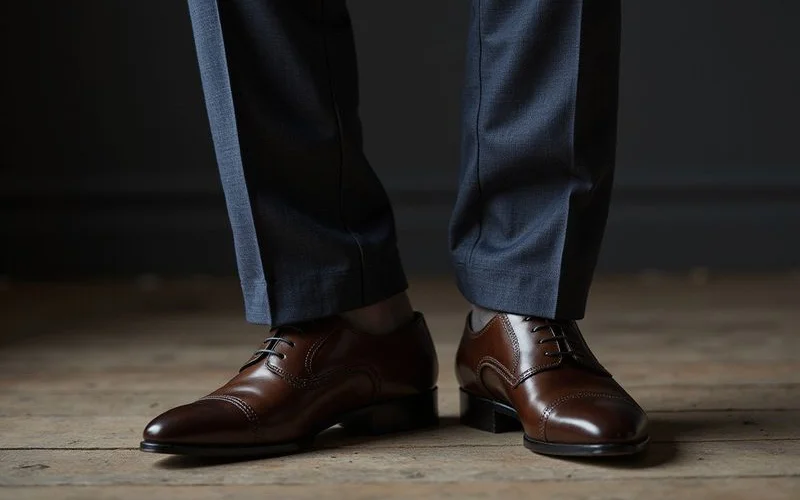
The break. The “break” refers to how much the trouser fabric folds where it meets your shoe.
- No break is clean and modern, popular in tech and creative offices
- Half break is the safest, most professional choice for most business environments in PJ
- Full break is traditional but easily looks sloppy if the trousers are too baggy
Checkpoint Eight: Movement
This is the checkpoint that most fit guides skip entirely. A suit only works if it lets you do your job. We always ask new clients to do four things during a fitting:
- Sit down on a normal chair
- Cross one leg over the other
- Reach forward as if shaking hands across a table
- Lift one arm to grab something from a high shelf
Any restriction during these movements is a fit problem, not a comfort preference. A properly cut bespoke jacket allows all four movements without lifting at the collar or pulling at the buttons.
Why Local Climate Changes The Rules
In a tropical city, the way a suit is constructed is as important as how it is cut. The cloth weight, the canvas type, and the lining choice all have to be tuned to PJ’s 80% humidity. Otherwise, even a beautifully-fit jacket becomes unwearable by mid-morning.
This is why our Lanwin Tailor commissions for local clients use lightweight high-twist wools, half or quarter linings, and breathable construction. The fit checkpoints above only matter if the suit can survive the conditions outside the showroom door.
Fit Is A Foundation, Not A Style
These checkpoints are the technical baseline. Personal style decides everything above that line, from lapel width to button stance to trouser silhouette. But none of those style choices matter if the basics are wrong.
When Your Wardrobe Fails The Test
If your current suits fail several of these checkpoints, you have three ways forward.
Alterations
A skilled tailor can refine an existing garment. We adjust sleeves, waists, and trouser hems for clients every week at our Petaling Jaya workshop. Just remember that shoulders and overall jacket length are rarely worth altering on a poorly built suit.
Made-to-Measure
This option modifies a standard pattern within preset tolerances. It is a clear upgrade from off-the-rack and works well if your build is reasonably standard.
Bespoke
A bespoke suit is built from a unique pattern drafted for your body alone. Every angle, slope, and posture quirk is accounted for. This is the only path that solves significant asymmetries or unusual proportions.
The Suit That Disappears
The ultimate test of a great suit is that you forget you are wearing it. There are no tight armholes pulling at your shoulders. No collar gap to fidget with. No waistband cutting into your stomach during a long lunch.
When the fit becomes invisible, the only thing left is your presence. That is what good tailoring is supposed to do.
If you are ready to build a wardrobe that meets these eight checkpoints, book a consultation with our Lanwin Tailor team and let us show you what a precision-cut suit feels like.
Louis Chua
Third-generation Master Tailor leading the Lanwin Tailor workshop in Petaling Jaya.